


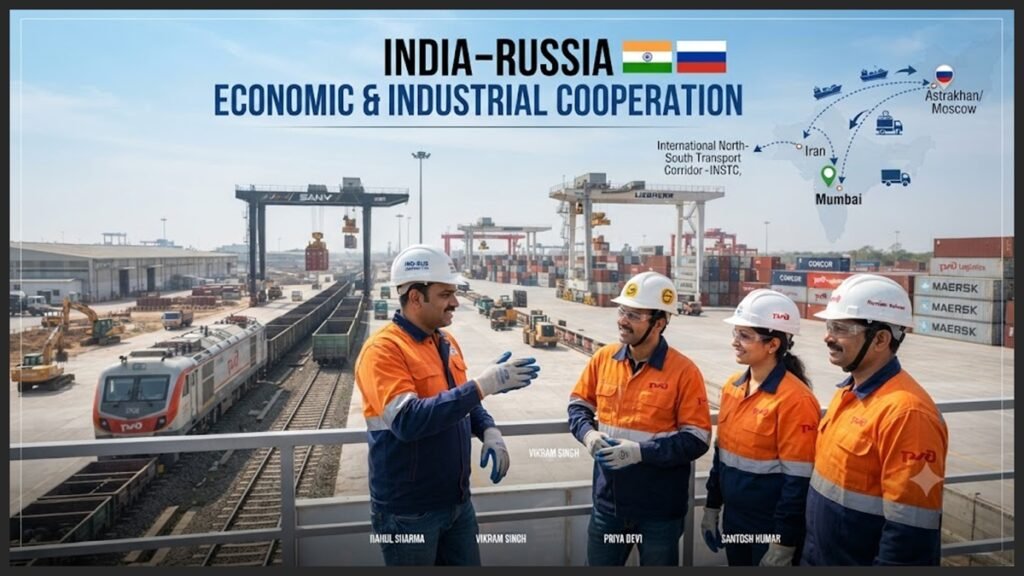


NEW DELHI — In a major expansion of bilateral economic and labor cooperation, Moscow has agreed to open approximately 70,000 jobs in Russia for Indian skilled workers this year. The recruitment drive will primarily focus on critical shortages across the construction and logistics sectors.
External Affairs Minister Dr. S. Jaishankar disclosed this development during a high-level meeting of the Parliamentary Consultative Committee on External Affairs in New Delhi. The session addressed multi-dimensional ties between India and Russia, spanning labor mobility, bilateral trade, international shipping corridors, energy cooperation, and citizen safety abroad.
Key Focus on Construction and Logistics
According to the Ministry of External Affairs (MEA), the move follows sustained bilateral consultations addressing labor market imbalances caused by demographic shifts and industrial demands inside the Russian Federation.
The agreement prioritizes technical roles, certified trades, infrastructure building, and freight management. As Russia accelerates infrastructure overhauls across its central and eastern territories, foreign labor pipelines are transitioning from traditional regional partners to certified workforces abroad. The deployment framework guarantees structured employment pathways, formal contracts, and labor protections under bilateral oversight.
Expanding Bilateral Trade Beyond Energy
Addressing the committee, Dr. Jaishankar underscored that both administrations are working deliberately to balance two-way trade. While India’s procurement of discounted Russian crude has anchored balance sheets over recent years, current efforts focus on scaling non-energy Indian exports across seven priority sectors:
- Automotive & Components: Specialized machinery, spares, and assembled commercial transport.
- Pharmaceuticals & Healthcare: Active pharmaceutical ingredients (APIs), essential generic medicines, and surgical equipment.
- Agriculture & Marine Products: Processed foods, grains, tea, coffee, and certified seafood products.
- Engineering Goods: Precision tools, metallurgical hardware, and heavy machinery components.
- Chemicals & Petrochemicals: Specialty organic compounds and agricultural inputs.
- Textiles & Apparel: Industrial fabrics, functional garments, and raw materials.
Minister Jaishankar reaffirmed that India’s multi-vendor energy strategy remains central to national energy security, protecting domestic consumers from global market volatility through diversified supply contracts.
Maritime Corridors and Free Trade Talks
The parliamentary briefing also reviewed progress on strategic transit routes aimed at shortening freight delivery schedules between South Asia and Eurasia. Discussions centered on three primary transit links:
- The International North-South Transport Corridor (INSTC): A 7,200-kilometer multimodal network connecting India, Iran, Azerbaijan, and Russia.
- The Chennai-Vladivostok Eastern Maritime Corridor: A sea route that reduces transit times between Indian ports and Russia’s Far East from 40 days to roughly 24 days.
- The Northern Sea Route (NSR): Arctic maritime passages being analyzed for long-term commercial viability.
Additionally, technical negotiations are advancing regarding a formal Free Trade Agreement (FTA) between India and the Eurasian Economic Union (EAEU)—comprising Russia, Belarus, Kazakhstan, Armenia, and Kyrgyzstan—designed to eliminate tariff barriers on key industrial and consumer goods.
Safeguarding Indian Nationals Abroad
The External Affairs Minister also updated lawmakers on ongoing diplomatic interventions concerning Indian citizens trapped in auxiliary roles within the Russian military amidst the Ukraine conflict.
Dr. Jaishankar confirmed that following persistent engagement between New Delhi and Russian diplomatic authorities, approximately 140 Indian nationals have been safely discharged and repatriated. Indian consular officials are currently working with Russian defense counterparts to locate, verify, and secure the release of an estimated 55 remaining individuals. Reaffirming India’s diplomatic posture, the Minister emphasized that dialogue and direct diplomacy remain the country’s primary avenues for supporting conflict resolution.
Conclusion
The expansion of bilateral ties reflects a strategic alignment between Russian labor needs and India’s demographic dividend. With verified channels replacing informal recruitment vectors, official frameworks provide safe, structured avenues for technical personnel seeking overseas appointments. Both governments are establishing clear regulatory protocols to ensure that qualifying candidates access legitimate, productive jobs in Russia for Indian skilled workers.
Frequently Asked Questions (FAQs)
Which industries have the highest demand for Indian workers in Russia?
The current quota prioritizes civil construction, industrial infrastructure, freight operations, supply chain logistics, and specialized engineering roles.
How can applicants ensure recruitment legitimacy for jobs in Russia?
Candidates should verify employment offers through the Ministry of External Affairs’ official eMigrate portal (emigrate.gov.in) and use only MEA-registered recruitment agencies to prevent deceptive enlistment or unregulated contracting.
What transit and trade corridors support this economic partnership?
Key infrastructure routes include the Chennai-Vladivostok Eastern Maritime Corridor, the International North-South Transport Corridor (INSTC), and proposed access paths along the Northern Sea Route.
Regulatory & Employment Disclaimer
This report is provided for informational and journalistic purposes only. It does not constitute legal, immigration, or recruitment advice. Job seekers should verify all foreign employment offers, visa categories, and agency credentials through official governmental channels, including the Ministry of External Affairs (India) and the Embassy of the Russian Federation.