


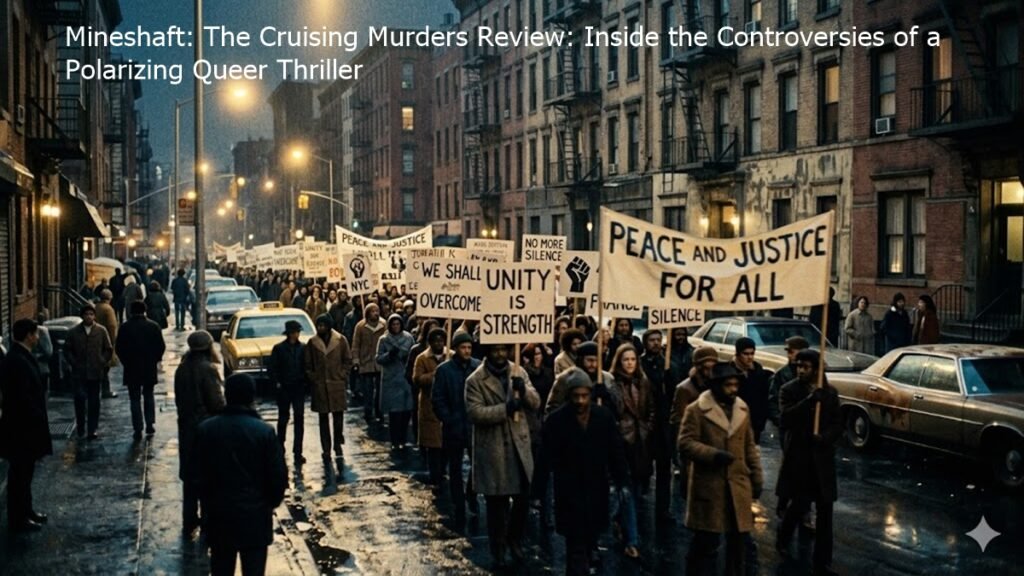


Director Jeffrey Schwarz tackles the intense controversy surrounding William Friedkin’s 1980 film Cruising in his new Tribeca Festival documentary, Mineshaft: The Cruising Murders. The film explores the real-life Manhattan homicides that inspired the gritty thriller, the massive LGBTQ+ activist protests during production, and the movie’s complex, enduring legacy within queer cinema and post-Stonewall social history.
Mineshaft: The Cruising Murders Review: Exploring the Controversial 1980 S&M Thriller
The Tribeca Festival recently hosted the Spotlight Documentary premiere of Mineshaft: The Cruising Murders, directed and edited by queer pop-culture documentarian Jeffrey Schwarz. This Mineshaft: The Cruising Murders review examines how the 84-minute film dives deep into William Friedkin’s highly polarizing 1980 crime thriller, Cruising.
Schwarz explores the project through a three-pronged lens: the real-life Manhattan homicides that inspired the story, the tense production on location in New York, and the historic LGBTQ+ activist protests that disrupted filming.
The Real-Life Crimes Behind the Script
A major strength highlighted in this Mineshaft: The Cruising Murders review is the documentary’s focus on the actual tragedies that caught director William Friedkin’s attention. The primary source material was the 1977 murder of Addison Verrill, a 36-year-old film reporter for Variety.
Verrill was killed in his apartment by Paul Bateson, a radiological technician whom he met at the West Village leather bar, the Mineshaft. In a bizarre twist of fate, Bateson had previously appeared in a minor medical scene in Friedkin’s 1973 horror classic, The Exorcist.
The documentary features moving interviews with Verrill’s sister, Pamela Verrill Walker, and his former romantic partner, Bob Geary. Geary shares his enduring trauma over how a real family tragedy was adapted into mainstream Hollywood entertainment without the director ever contacting the victim’s inner circle.
Furthermore, Friedkin drew inspiration from “The Bag Murders”—a series of unsolved dismemberments involving gay men whose remains were recovered from the Hudson River. While Bateson allegedly boasted of these crimes while awaiting trial for Verrill’s murder, he was never charged due to a lack of physical evidence.
Production Backlash and Activist Resistance
When production began on Cruising in the late 1970s, the landscape of LGBTQ+ representation in Hollywood was incredibly limited. Because gay men rarely saw themselves portrayed with complexity on the big screen, the announcement of a mainstream studio film focusing entirely on violence, murder, and S&M subculture sparked immediate alarm.
Journalist Arthur Bell used his platform at The Village Voice to sound the alarm after a production insider leaked the script. Bell warned readers that the film promised to be deeply oppressive and bigoted. His articles galvanized thousands of LGBTQ+ rights activists, who flooded the filming locations to disrupt the shoot with whistles, sirens, and light reflections.
According to community figures interviewed in the documentary—including Dan Savage, Michael Musto, and Vito Russo via archival context—the protests became a historic moment of queer solidarity. Activists feared the film would validate homophobic prejudices and incite real-world hate crimes. The intense pushback heavily rattled the movie’s star, Al Pacino, who ultimately distanced himself from the project and skipped promotional press tours.
Evaluating the Documentary’s Structure
As noted in our Mineshaft: The Cruising Murders review, the documentary occasionally struggles to fluidly balance its complex themes. By trying to cover the true-crime mechanics, the behind-the-scenes movie lore, and the historical evolution of queer cinema all within a 90-minute runtime, the narrative structure can feel disjointed.
The documentary features archival commentary from Friedkin, who passed away in 2023. Friedkin consistently maintained that his thriller was an exploration of a closed subculture rather than a reflection of the entire gay community. However, the film notes that his defense often came across as dismissive of the community’s valid anxieties regarding mainstream stigmatization.
Musically, the documentary benefits from a period-evocative synthwave score composed by Makeup and Vanity Set (Matthew Steven Pusti), which captures the gritty atmosphere of late-1970s New York.
An Invaluable Historical Time Capsule
Despite its structural fragmentation, the documentary serves as a vital historical record. Decades after its release, Cruising has transitioned from an active political battleground into a rare cinematic window showing pre-AIDS queer hedonism.
The film captures an era of physical networking, leather bars like Badlands and Sneakers, and the sexual playgrounds of the Meatpacking District and the West Side piers. Ultimately, Schwarz’s documentary outlines how the passage of time and the expansion of diverse queer representation have softened the movie’s initial toxicity, reframing it as an unsettling yet fascinating piece of social history.
FAQs on Mineshaft: The Cruising Murders Review
What is the main focus of the documentary Mineshaft: The Cruising Murders?
The documentary investigates the real-life murders of gay men in 1970s New York, how those crimes inspired William Friedkin’s controversial 1980 film Cruising, and the massive LGBTQ+ protests that took place during production.
Who directed the documentary?
The film was directed and edited by Jeffrey Schwarz, a veteran documentarian known for queer pop-culture histories such as Vito, I Am Divine, and Tab Hunter Confidential.
Why was the 1980 film Cruising so controversial?
Activists protested the film because they felt portraying the gay leather and S&M scene through a violent crime thriller would promote dangerous stereotypes, validate homophobia, and potentially trigger anti-gay hate crimes at a time when positive queer representation did not exist.
Who was Paul Bateson?
Paul Bateson was a medical technician convicted of murdering Variety reporter Addison Verrill in 1977. He had a brief cameo in William Friedkin’s The Exorcist and was a key inspiration for the movie Cruising.
Disclaimer on Mineshaft: The Cruising Murders Review
The information presented in this article is intended strictly for journalistic, educational, and entertainment reporting purposes. The views expressed regarding the documentary and historical films reflect those of the respective filmmakers, subjects, and critics, and do not constitute an endorsement or promotion of any specific viewpoint.