


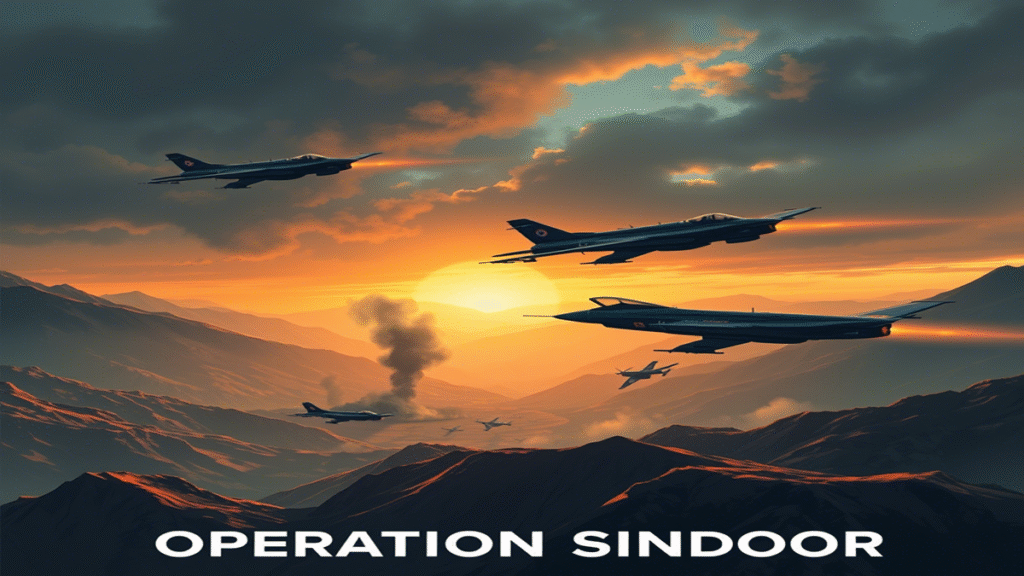


In response to the brutal killing of Indian civilians in Pahalgam on April 22, India launched Operation Sindoor airstrikes, a large-scale military campaign targeting terrorist infrastructure in Pakistan and Pakistan-occupied Kashmir (PoK). The operation lasted from May 7 to May 10 and marked a decisive shift in India’s counter-terrorism strategy, emphasizing a policy of direct retaliation and zero tolerance.
Over four days, Indian armed forces destroyed nine terror camps, including those linked to Lashkar-e-Taiba, Jaish-e-Mohammed, and Hizbul Mujahideen. Intelligence agencies confirmed these camps served as planning and training centers for cross-border attacks. More than 100 terrorists were killed in the strikes, including key figures involved in the 1999 IC-814 hijacking and the 2019 Pulwama suicide bombing.
The Operation Sindoor airstrikes prompted a retaliatory response from Pakistan, which used drones and missiles to target border regions in Jammu & Kashmir, Punjab, and Rajasthan. India responded strongly, leading to a series of drone and missile exchanges and artillery fire along the Line of Control. The confrontation pushed both nations to the brink of war before a ceasefire agreement was reached on May 10, halting all military activities across land, sea, and air.
In an unprecedented move, Indian forces extended their operation deep into Pakistan’s mainland, targeting terror hubs in Bahawalpur and other sensitive locations within Punjab province. Indian Air Force jets carried out pinpoint strikes on militant infrastructure previously untouched even by international forces. These Operation Sindoor airstrikes demonstrated India’s resolve to hit targets deep within enemy territory if provoked by terrorism originating from there.
Government sources stated that India had drawn a new red line: states using terrorism as a strategic tool would face direct and immediate military consequences. Prime Minister Narendra Modi directed that any action by the Pakistani military be met with a stronger Indian response. This operation also rejected previous distinctions between individual terrorists and state sponsors, explicitly holding Pakistan’s government responsible.
The Indian Air Force executed these deep-penetration strikes in just 23 minutes using Rafale fighter jets armed with SCALP missiles and HAMMER bombs. No civilian casualties were reported. India’s Akashteer air defense system also intercepted hundreds of Pakistani drones and missiles, revealing critical gaps in Pakistan’s aerial defense network while displaying India’s advanced capabilities.
During the Operation Sindoor airstrikes, Indian forces targeted 11 Pakistani Air Force bases. Strikes on Nur Khan, Rafiqui, Murid, Sukkur, and Jacobabad airbases damaged nearly 20 percent of Pakistan’s military aviation infrastructure. Over 50 personnel, including Squadron Leader Usman Yusuf, were reported dead, and multiple aircraft were destroyed at Bholari airbase.
The operation showcased exceptional coordination among the Indian Army, Navy, and Air Force—an example of modern joint warfare. It underlined India’s evolving combat strategy and sent a clear global message: India will not wait for international consent to protect its citizens.
Unlike previous conflicts where world powers urged restraint, Operation Sindoor airstrikes received broad international support. For the first time, the global narrative around India-Pakistan tensions shifted from Kashmir to terrorism. India’s precise and lawful strikes on terror facilities were seen as a legitimate act of self-defense.
Conclusion:
Operation Sindoor airstrikes not only avenged the Pahalgam killings but also set new benchmarks for India’s anti-terror response. By executing targeted, high-impact strikes deep into Pakistani territory, India demonstrated its capacity and willingness to neutralize threats at their source. This operation established a powerful precedent and redefined the rules of engagement in South Asia’s security environment.
Also Read: Operation Sindoor: A Strategic Milestone in India’s Security Framework for SSC, CBSE, ICSE Students