
U.S. Student Visa Shake-Up: What Indian Students Must Know About the Four-Year Limit and Renewal Rules
Key Developments in the Policy
The U.S. Department of Homeland Security (DHS) has put forward a proposed regulation that could transform the way international students—including Indian nationals—access and maintain the F-1 Visa. Major points include:
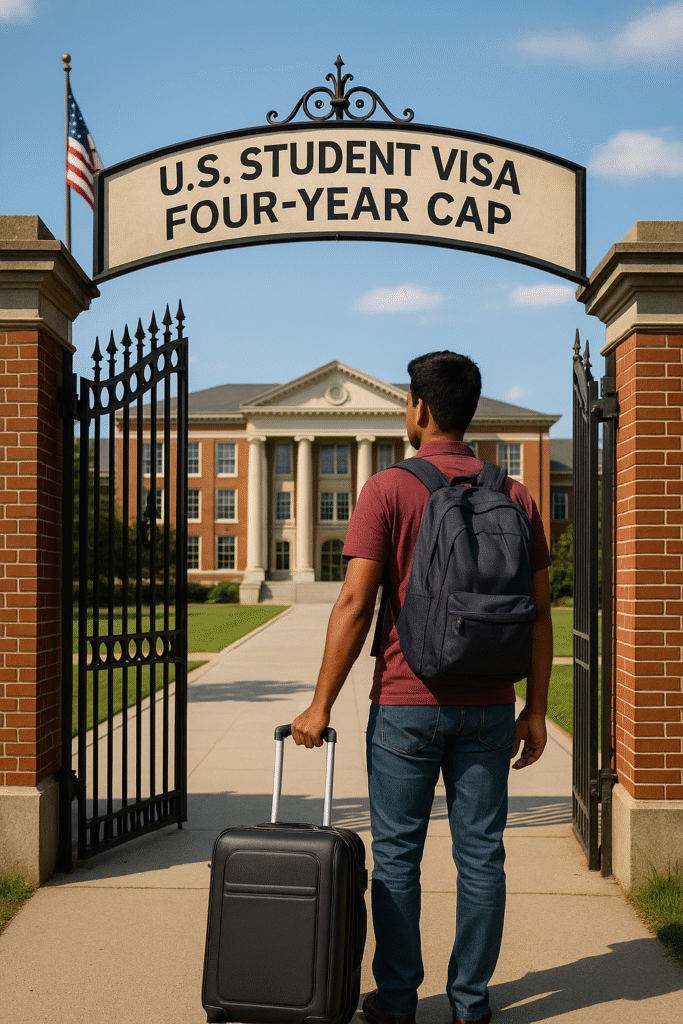
- Under the proposed rule, F-1 visa holders would no longer be covered by the existing “duration of status” (D/S) framework. Instead, they would be admitted for a fixed period of stay up to four years, after which any continuation of study beyond that requires a formal extension application.
- The grace period after completion of studies (and any associated work authorisation) would shrink from 60 days to 30 days for F-1 students.
- The rules would also tighten students’ ability to change programmes, level of study or enrol in back-to-back degrees at the same level—a practice often termed “programme stacking”.
- In parallel, the longstanding “interview waiver / drop-box” facility for visa renewals appears to be significantly constrained, meaning more students may need to attend in-person consular interviews when renewing their visas.
Why These Changes Matter to Indian Applicants
Impact on Longer Courses & PhD Aspirants
Indian students who enrol in doctoral programmes, research-intensive courses or combined master’s-PhD tracks (which often span more than four years) could face the risk of needing to apply for extensions mid-course. If the four-year cap is triggered, they may have to:
- Stop their programme and seek a change of status.
- Apply for an extension through U.S. Citizenship and Immigration Services (USCIS) which may involve additional documentation, fees, and delays.
- Face uncertainty in planning internships, practical training or employment linked to their studies.
Renewal & Travel Disruption
If renewal interviews become mandatory (instead of drop-box), Indian students returning home during breaks could face longer waiting times for visa interviews, potentially delaying their return to the U.S. Additionally, tighter rules may heighten the risk of visa delays or denials.
Strategic Choices for Applicants
- Applicants may prefer shorter-duration programmes (say 2-3 years) to stay within the four-year cap.
- Consider alternatives like the O‑1 Visa for “extraordinary-ability” individuals: students with significant awards, research publications or exceptional credentials might qualify.
- Consult your university’s international student office early to understand how the rule change may affect your programme and plan accordingly.
Expert & Institutional Reactions on US F-1 student visa four-year cap for Indian students
Leading education-advocacy groups and higher-education institutions in the U.S. have raised concerns. For example, NAfSA: Association of International Educators has argued that a four-year cap may deter international students and damage U.S. higher education’s global competitiveness.
Critics also warn the change creates added bureaucratic burdens, increased uncertainty and possible disruptions for students mid-program.
FAQ: Frequently Asked Questions on US F-1 student visa four-year cap for Indian students
Q1. Does the “US F-1 student visa four-year cap for Indian students” mean I cannot study beyond four years?
A1. No—not exactly. The four-year limit refers to the maximum initial authorised stay under the proposed rule. If your course exceeds four years, you may apply for an extension with USCIS—but the policy introduces that extra step and associated risk.
Q2. Will the cap apply immediately to students already in the U.S. or planning now?
A2. Currently, the rule is in the proposed stage. The comment period is open (for example, through September 2025) and final implementation may take time. Existing students may still fall under old rules until a final regulation is published.
Q3. How does this affect renewing my visa or travel plans?
A3. With stricter renewal interviews likely, Indian students renewing their F-1 visas should anticipate: in-person consular interviews instead of drop-box, longer waiting times, and potential delays in travel back and forth between India and the U.S. planning for rotations or internships.
Conclusion on US F-1 student visa four-year cap for Indian students
For Indian students aspiring to study in the U.S., the “US F-1 student visa four-year cap for Indian students” signals a critical shift in visa policy that demands proactive planning. While the proposed rule is not yet final, restarting studies without awareness could lead to complications in programme completion, visa renewals or travel. Ensuring you choose the right programme duration, monitor regulatory updates via the U.S. Department of Homeland Security (DHS) and your institution’s international office, and prepare for potential visa-renewal changes will help protect your academic pathway and future ambitions.
Disclaimer on US F-1 student visa four-year cap for Indian students
This article is intended for informational purposes only and does not constitute legal or immigration advice. Applicants should consult a qualified immigration attorney or their university’s international student office for personalised guidance.
Also Read: Team India Diwali Dinner Adelaide 2025: Indian Cricket Team Celebrates Festival on Tour